Gone from the Promised Land by John R. Hall
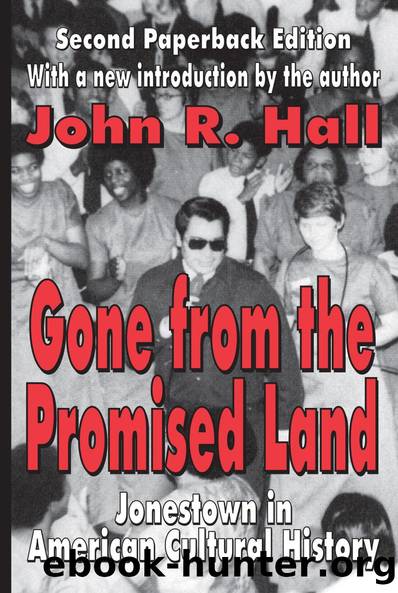
Author:John R. Hall [Hall, John R.]
Language: eng
Format: epub
Tags: History, General, Religion, Cults
ISBN: 9781351516907
Google: OmymDwAAQBAJ
Publisher: Routledge
Published: 2017-07-12T04:59:11+00:00
Guyana and the Mission Post
The country of Peoples Templeâs Promised Land was hardly paradise, and historically, most colonists had purely economic motives. For centuries major European colonial powersâthe Dutch, the French, and the Englishâhad fought for control of both the Caribbean coastline of South America and the river trade routes that led upstream into the Guiana jungle highlands, south toward Brazil. They wanted the coastal land to grow sugarcane, and they wanted to use the rivers to exploit a handy smuggling trade that sidestepped Brazil. The jungle started a mere ten miles back from the fertile swamplands along the coast, and as far as the European adventurers were concerned, the Indians could have it. The cli-mate was not much to brag about either. What with hot, muggy weather and a rainy âseasonâ that had no predictable beginning or end, most Europeans hardly considered the Guianas a garden spot for colonization.
True, Puritans leaving England to escape persecution seriously considered the Guianas as a possible promised land themselves, enticed by Sir Walter Raleighâs description of a âcountrie . . . rich, fruitful and blessed with a perpetual spring, where nature brought forth all things in abundance without any great labor or art of man.â But the sober-minded pilgrims worried about the inhospitable Spanish and about âhot countries,â and they chose to migrate to New England instead. By the time Britain consoli-dated political control over its share of the Guianas in 1814, it was abundantly clear that the land would not become a colony for smallholder settlers of English stock. Instead the small elite class of English plantation owners at first used Indians, then African slaves, and finally indentured East Indian âservantsâ to work the cane fields. The sleepy political economy of British Guiana was disturbed only by a nagging border dispute with Spanish-settled Venezuela to the west. Despite the fact that the colonial backwater was located on the continent of South America, it developed the ethnic and cultural diversity of the Caribbean islands it faced to the north; it was, above all, a British colony.
Like most great powers, Britain gave way to the post-World War II drive for independence in its colonies. The vast majority of the former colonial rulers deserted the new nation called Guyana. As in many other parts of the Third World, political activity fell to the agricultural working classes, and in this case they took socialist and communist directions, split along the ethnic cleavages established by the phases of British colonialism. The less radical socialist party, the Peopleâs National Congress (PNC), was overwhelmingly dominated by Guyanese of African descent, led by Forbes Burnham. The more radical Marxist-Leninist party, the Peoples Progressive party (PPP), included most of the approximately 54 percent of the population of East Indian descent, led by Cheddi Jagan.
After Guyana attained independence in 1964, the PNC consolidated effective monopoly power through a series of maneuvers, some of them shady, that marginalized the more radical PPP. British and U.S. intelligence agencies were faced with a distasteful choice
Download
This site does not store any files on its server. We only index and link to content provided by other sites. Please contact the content providers to delete copyright contents if any and email us, we'll remove relevant links or contents immediately.
| Anthropology | Archaeology |
| Philosophy | Politics & Government |
| Social Sciences | Sociology |
| Women's Studies |
Cecilia; Or, Memoirs of an Heiress — Volume 1 by Fanny Burney(32538)
Cecilia; Or, Memoirs of an Heiress — Volume 2 by Fanny Burney(31935)
Cecilia; Or, Memoirs of an Heiress — Volume 3 by Fanny Burney(31925)
The Great Music City by Andrea Baker(31911)
We're Going to Need More Wine by Gabrielle Union(19032)
All the Missing Girls by Megan Miranda(15927)
Pimp by Iceberg Slim(14476)
Bombshells: Glamour Girls of a Lifetime by Sullivan Steve(14046)
For the Love of Europe by Rick Steves(13870)
Talking to Strangers by Malcolm Gladwell(13341)
Norse Mythology by Gaiman Neil(13332)
Fifty Shades Freed by E L James(13228)
Mindhunter: Inside the FBI's Elite Serial Crime Unit by John E. Douglas & Mark Olshaker(9313)
Crazy Rich Asians by Kevin Kwan(9271)
The Lost Art of Listening by Michael P. Nichols(7487)
Enlightenment Now: The Case for Reason, Science, Humanism, and Progress by Steven Pinker(7303)
The Four Agreements by Don Miguel Ruiz(6739)
Bad Blood by John Carreyrou(6609)
Weapons of Math Destruction by Cathy O'Neil(6261)
